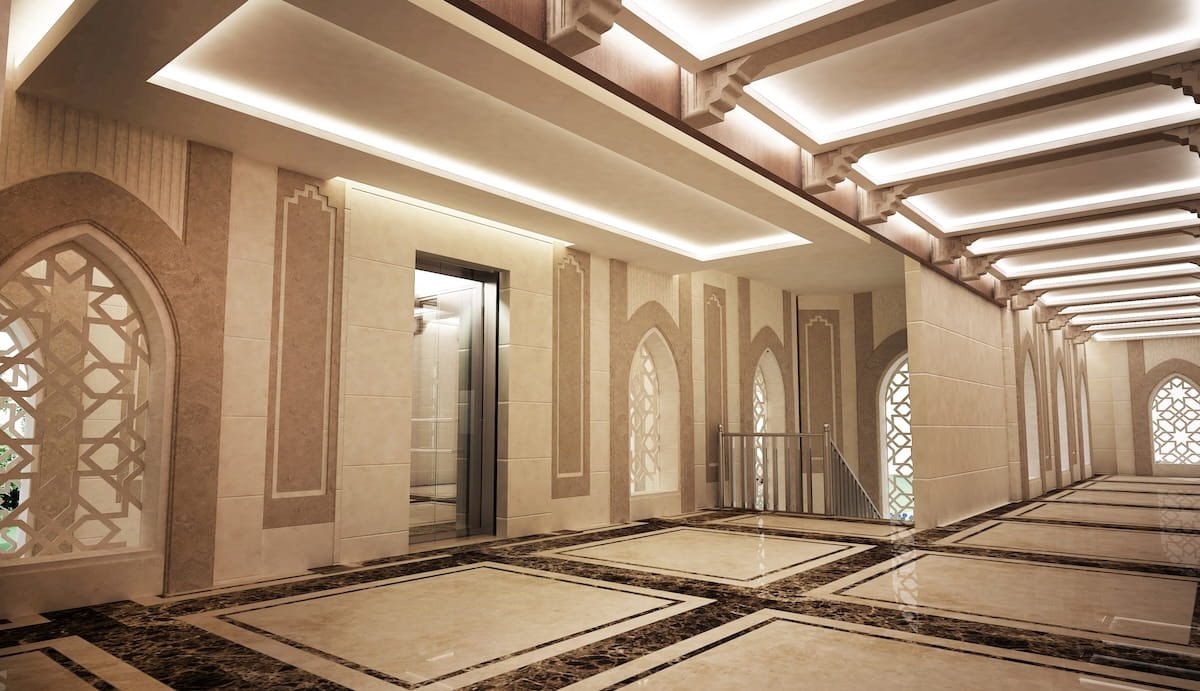
The women entry accommodates a disable lift and two separate wide staircases to prevent congestion and allows for safe and dignified widened entry and exit halls. The entry hall has direct access with two large doorways to women prayer area and by using surrounding corridor way to women ablution and sanitary area and multipurpose community area.
This account turns to a group of elements that are essential to the environmental and architectural character of the Australian Islamic House. The focus falls on Masharabiyas (Shading Devices), the Riwaq (Arcade) – Walkway (Multifunctional Corridor), and the relationship between exterior wall cladding, light control, airflow, and privacy. Read together, these elements show how the mosque’s outer envelope does more than define its appearance. It regulates climate, filters light, shapes circulation, and gives architectural form to a traditional Islamic language reinterpreted through contemporary design. The shaded corridor, the repeated arched openings, the perforated screens, and the light color stone finish all work together to create an exterior architecture that feels calm, ordered, and environmentally responsive.
First Floor Multi-Functional Transition Entrée
The entry from the ground floor female entry to the female prayer hall is shaped by two wide staircases and a disable lift that lead into a large first floor entrée designed for preparation before entering the prayer hall.
This large entrée also functions as a multi-functional transition zone connected to the surrounding corridor, with two different directions, alternative entries, and access to the female ablution section, library, child play area and women’s management room of the mosque. In this sense, it is both symbolic and practical. It accommodates preparation, orientation, and circulation at once. Worshippers are able to pause, remove shoes, and move away from the demands of daily life before entering the main prayer space. The threshold is therefore not simply crossed; it is briefly inhabited as part of the mosque’s interior order.
Riwaq (Arcade) – Walkway (Multifunctional Corridor)
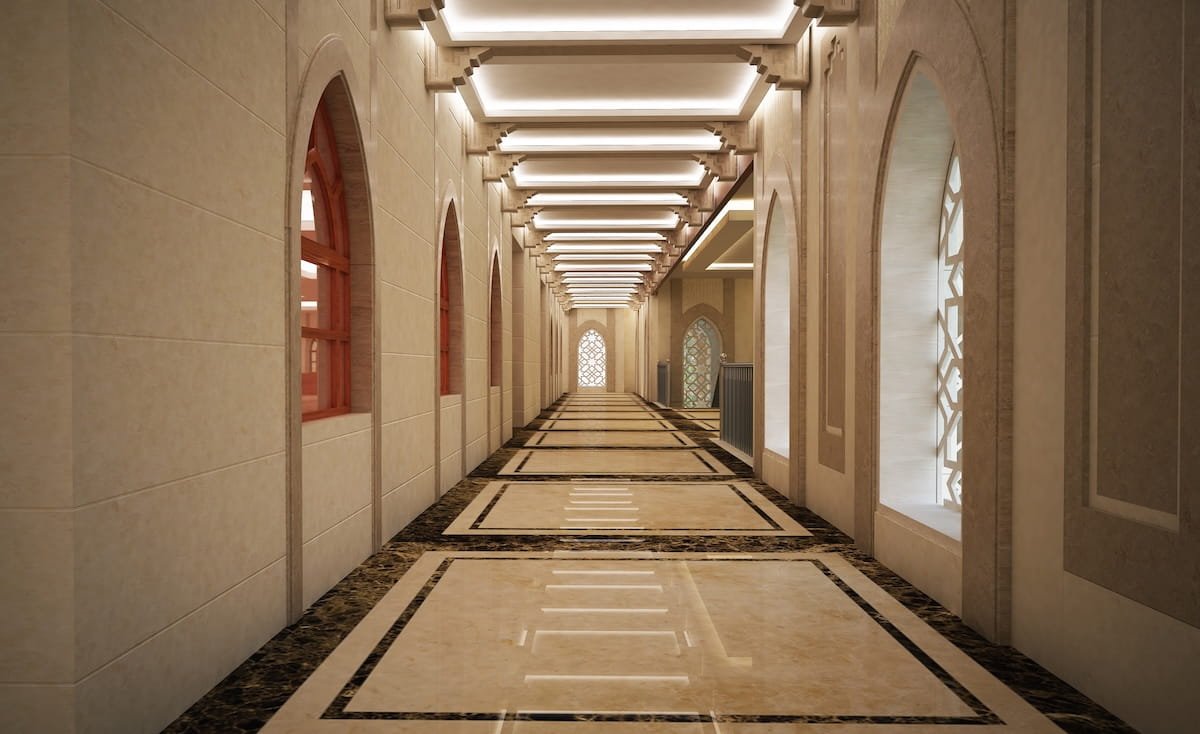
The riwaq (surrounding corridor) is one of the most important transitional elements in Islamic architecture, typically taking the form of an arcade or portico between indoor and outdoor areas. In the Australian Islamic House, it is reworked as a multifunctional corridor that manages light, provides shaded circulation, and creates a social, semi-public space. This is a significant architectural move because it allows the walkway to operate on several levels at once. It is a route of movement, a climatic buffer, and a place of pause.
Encircling the mosque, the Riwaq (arcade) provides a continuous, shaded, step-free walkway, allowing all worshippers, including those with disabilities, to navigate the mosque independently. Accessibility here is not treated as an isolated technical adjustment. It is integrated into the architectural language of the corridor itself. The walkway is conceived as a climate-responsive shelter using arched windows with masharabiyas (shading devices) and multiple door openings. Coupled with strategically placed doors on opposite sides, these create effective cross-ventilation and thermal comfort. Through this passive design technique, airflow is regulated, solar heat gain is reduced, indoor air quality is improved, and reliance on mechanical systems is lessened.
This also gives the walkway a broader architectural importance. It becomes a space where environmental intelligence and ceremonial movement meet. Worshippers do not simply pass besides the building. They move through a shaded and breathable architectural threshold that extends the mosque’s spatial presence outward. The rendering on page 1 makes this especially clear through the long covered passage, the repeated structural rhythm, and the filtered openings along the wall. The corridor feels neither fully exterior nor fully interior. It occupies that important intermediate condition that the riwaq has historically sustained.
A Facade Shaped by Shade, Air, and Continuity
Taken together, the mashrabiya, the riwaq, and the light color stone wall cladding reveal a facade built on more than image alone. They form a coordinated architectural system in which privacy, ventilation, shading, circulation, and material unity all reinforce one another. What makes this structure especially compelling is the way it carries traditional architectural intelligence forward without imitation. The screens remain culturally resonant, the walkway remains socially and climatically useful, and the wall remains both protective and expressive. In the Australian Islamic House, exterior architecture becomes a carefully balanced field where sustainability, spiritual ambiance, and architectural continuity are brought quietly into one coherent whole.
The architectural reading continues below with the next article, which turns to the women’s prayer hall, the community life of the upper level, and the role of fire safety in shaping an architecture of care, inclusion, and everyday use.
Previous Article
Female Entry, External Walls, and the Architecture of Dignified Enclosure
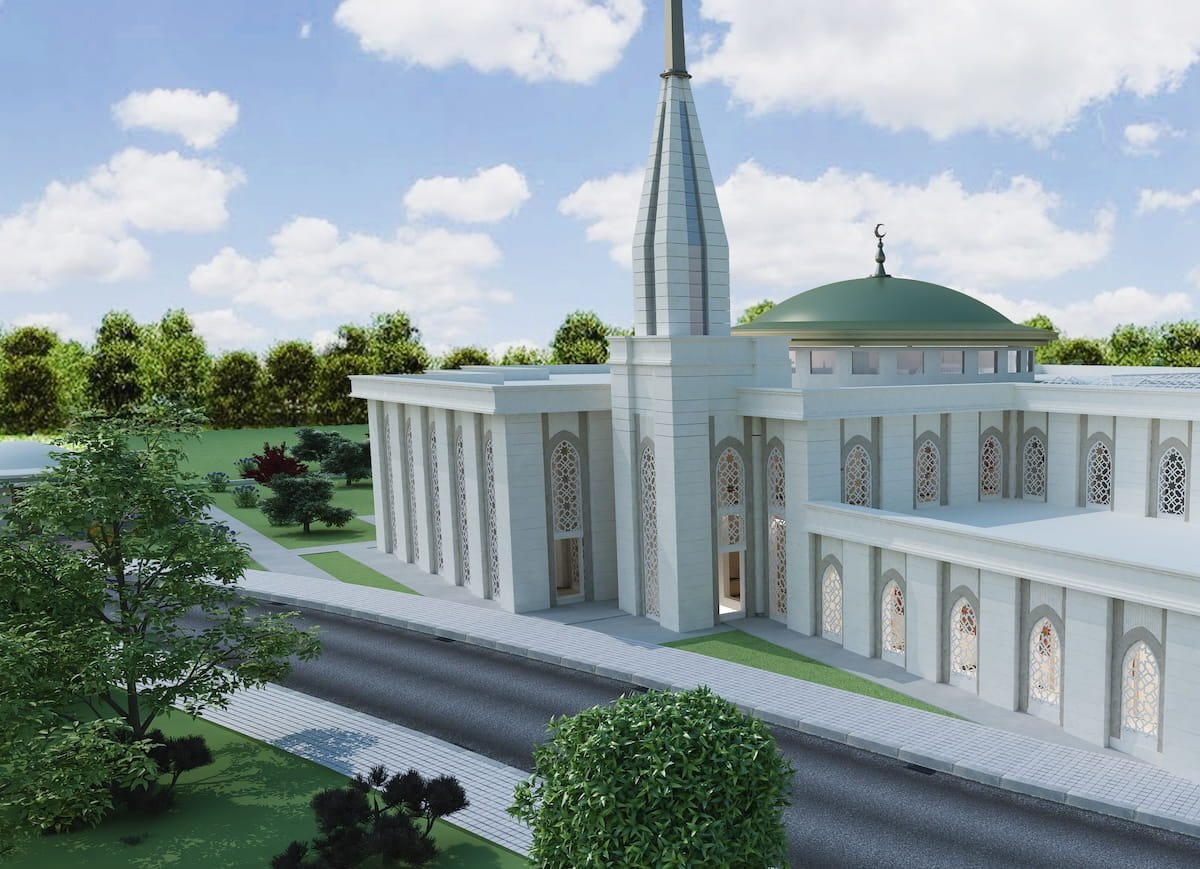
This article explores how the Australian Islamic House handles privacy, access, and exterior identity through the relationship between the female entry, the external walls, and the mashrabiya screen system. To understand this relationship between privacy, access, and facade more fully, read the detailed article.
Next Article
Women’s Prayer Hall, The Community Life of the Upper Level and Fire Safety
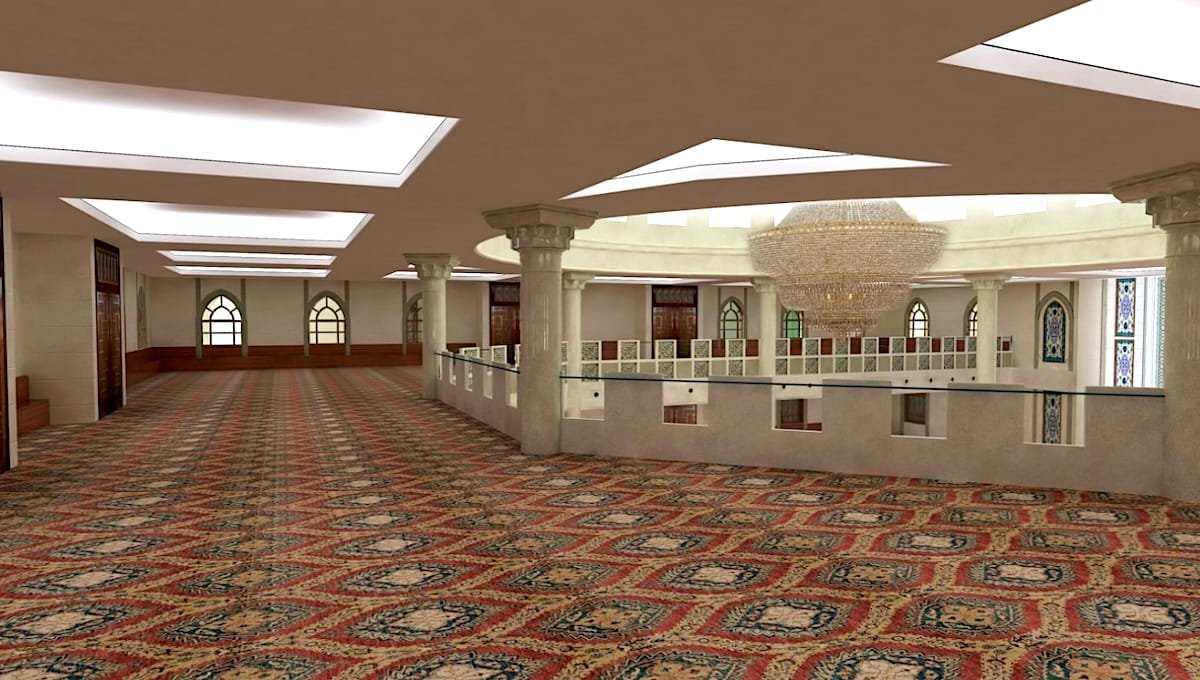
This article turns to the upper levels of the Australian Islamic House, showing how women’s worship, community life, and fire safety are brought into a single architectural framework shaped by care, inclusion, and everyday use. Together, these elements reveal an architecture in which protection, hospitality, accessibility, and communal support are given clear and durable form. To learn more about these upper-level spaces, read the extended reading.