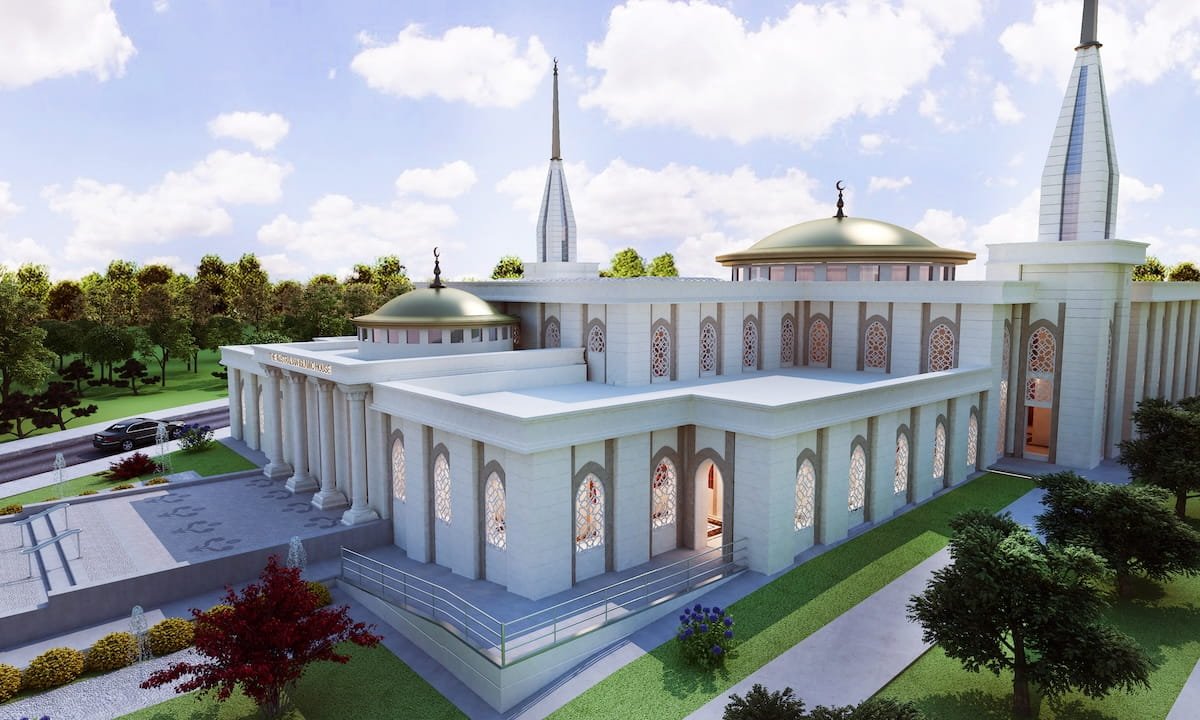
Australian Islamic House is a distinguished building set within the expanding suburban fabric of Edmondson Park. It brings worship, community life, and architectural clarity together in a single composition. The design of the mosque centers on movement and gathering, and on the relationship between threshold and prayer. It is an architectural work shaped by the need to give lasting form to a living institution.
The architectural meaning of this distinguished building cannot be considered separately from the question of design authorship. This article states that the design of both the architecture and the interiors belongs to Leyla Baydar Guven, and identifies her as the architect of Australian Islamic House (1). In a project of this kind, continuity and care matter. This article explains the continuity and care reflected in the building’s spatial logic, formal language, and atmosphere from the earliest design stage through to its completion.
A Community-Centered Project with Deep Roots
The design process for this mosque began in 1997 through a formal commission issued by the Australian Islamic House Management Committee. Relevant records show that approval for its staged development was granted in 1998. The mosque and fountain were designed first, followed by a meeting hall and then classrooms. In its first stage, the mosque was opened to the public on 28 February 2025. These dates matter. They remind us that the building should be understood not within a standard construction cycle, but within a long public timeline shaped by a range of values. The careful work behind this project points to a steady commitment to creating a religious and communal center, with the hope that it will endure for many years.
The location of the mosque adds further value to this architectural narrative. Edmondson Park is part of a rapidly changing Western Sydney. Census data presents a suburb defined by youth, density, and cultural plurality. In the 2021 Census, Edmondson Park had a recorded population of 12,080, with 19.0 percent of residents identifying as Muslim (2). The institution’s own public materials state that it has served the Muslim community for more than 30 years. They also describe a broader program that includes religious and social services, education, library facilities, and future multifunctional spaces. Taken together, these details underline that the project should be understood not only as a mosque building, but also as part of the social infrastructure of a growing urban edge.
Threshold, Procession, and the Architecture of Arrival
One of the building’s most valuable architectural qualities lies in the way it stages entry. The project record states that the main approach is defined by arched doorways, a columned riwaq or portico, the courtyard, and then the prayer hall. This architectural sequence is more than formal decoration. It gives arrival a measured rhythm and turns transition into part of the religious experience. The building does not rush the visitor inward. Instead, it creates a gradual movement from the open exterior to a sheltered threshold, then to the shared courtyard, and finally to the interior space of worship.
Louis Kahn’s observation that architecture is “the thoughtful making of spaces” offers a useful way to understand this aspect of the design (3). The strength of the project lies less in formal novelty than in the disciplined shaping of transition, pause, and orientation. Arcaded galleries do more than animate the facade. They organize circulation, establish hierarchy, and mediate between the public approach and the stillness of the interior. In this sense, built form and ritual use are closely aligned. The architectural responsibility here has not been limited to the prayer space alone. The careful integration of movement and light into the building creates a spatial and spiritual atmosphere that prepares both mind and body for the experience of prayer.
Tradition Reinterpreted Through Contemporary Form
The project documentation places the design in dialogue with the Faisal Mosque in Islamabad (4), designed by the Turkish architect Vedat Dalokay. This connection is valuable because it clarifies the architectural attitude behind the building. The relationship during her work as an assistant architect with Mr.Dalokay (1981-1982) here lies not only in resemblance, but in method. The Australian Islamic House incorporates recognizable elements such as domes, minarets, arches, and courtyard space. Yet it treats them not as static quotations borrowed from the past, but as part of a living design language.
This delicate balance between inheritance and reinterpretation defines much of the building’s character. The official records of the project show that symbolism, spiritual requirements, local culture, and human-centered functional planning were considered together throughout the design process. Read architecturally, this points to a project that does not attempt to replicate another geography wholesale. Instead, it translates an Islamic architectural vocabulary into the conditions of contemporary suburban Australia. The result is a mosque whose symbolic language remains legible while its architectural presence belongs to its own place and time. Its composition relies on balance and clarity rather than excess. In this way, recognizable forms carry spiritual value and meaning without losing spatial discipline.
An Integrated Design Authorship
The design authorship of the Australian Islamic House becomes clear at this point. Official records identify Leyla Baydar Guven not only as the architect of this project, but also as its interior designer. They connect her to the design process at the level of site planning, functional programming, and key architectural elements, including the mihrab, minarets, dome, courtyard, and ablution areas. These documented components within the project record help explain the building’s sense of coherence. The fact that architectural elements such as exterior form, interior atmosphere, symbolic detail, and circulation were conceived within a single design vision further strengthens the architectural value of the building.
Independent heritage documentation provides a broader professional framework for this attribution. National Trust NSW records Leyla Baydar Guven’s role in the Auburn Gallipoli Mosque (5). It emphasizes that her professional contribution was fundamental, within the context of mosque architecture, to the reestablishment of Ottoman architectural symbolism and structural logic under Australian conditions. When this background is considered together with the records relating to the Edmondson Park project, it shows that Ms. Guven’s role in Australian mosque architecture has been competently and officially documented from outside sources, and professionally recognized by relevant international authorities. Within this context, the attribution of the architectural design of the Australian Islamic House to Leyla Baydar Guven takes its proper and fully justified place within a broader framework.
Civic Presence and Belonging
The cultural significance of the building lies in the way it brings religious life and public life together. Community reporting on the opening stated that more than 5,000 worshippers attended on the first day (6). This pointed to the scale of expectation and collective investment carried by the project. The institution’s stated aim also extends far beyond a prayer space alone. It reaches toward education, welfare, family life, and future public uses. From an architectural perspective, this matters. A mosque in a rapidly growing suburb does more than mark the skyline. It helps shape belonging, memory, and continuity for the community around it.
Seen in this light, the Australian Islamic House is best understood both as a carefully composed work of architecture and as a lasting symbol of community. Its value lies in the calm of its spatial sequence and the clarity of its symbolic language. Another important element that underscores the value of the project is the way ritual use has been translated into architectural form without losing public openness. To emphasize this building architecturally as a design by Leyla Baydar Guven is not to impose an external claim upon it. It means reading the work more deeply and understandings how design authorship, architecture, and cultural meaning come together here in quiet harmony.
Professional Team and Project Contributions
The Australian Islamic House was developed under the architectural direction of Leyla Baydar Guven through sustained collaboration with specialists in structural engineering, transport and infrastructure planning, landscape architecture, environmental planning, and building-code compliance.
A separate page presents the professionals involved in the project, explains their respective roles and contributions, and includes the original landscape drawing register prepared for the site. Read the full overview of the professional team involved in the Australian Islamic House project.
Architect – Interior Designer: Leyla Baydar Guven
Structural Engineer: Majed Hawatt
Consulting Engineer, Transportation and Environmental Planner: Lyle Marshall
Landscape Architect: Scott Murray
Environmental Planner: Neil Kennan
Sources and Documentation
- The Australian Islamic House official website:
Institutional history, programme, and community role.
taih.org.au/ - Australian Bureau of Statistics, 2021 Census QuickStats, Edmondson Park:
Demographic and religious affiliation context.
abs.gov.au/census/find-census-data/quickstats/2021/SAL11386 - The Museum of Modern Art, “Kahn Educator Guide”:
Source for the Louis Kahn quotation referenced in the article.
moma.org/pdfs/moma_learning/docs/kahn_full.pdf - Archnet, “Faisal Mosque, Islamabad”:
Architectural context for the project’s engagement with Islamic design traditions.
archnet.org/sites/649 - National Trust NSW, “Auburn Gallipoli Mosque”:
Independent heritage context for Leyla Baydar Guven’s documented role in Australian mosque architecture.
nationaltrust.org.au/initiatives/auburn-gallipoli-mosque/ - AMUST, “…opening stated that more than 5,000 worshippers…”:
Opening date and public context.
amust.com.au/2025/03/historic-grand-opening-of-masjid-al-bayt-al-islami/
The architectural reading continues below with the building’s approach, entry sequence, and public presence.
Next Article
Entry Portal, Minarets, Parking and the Architectural Approach
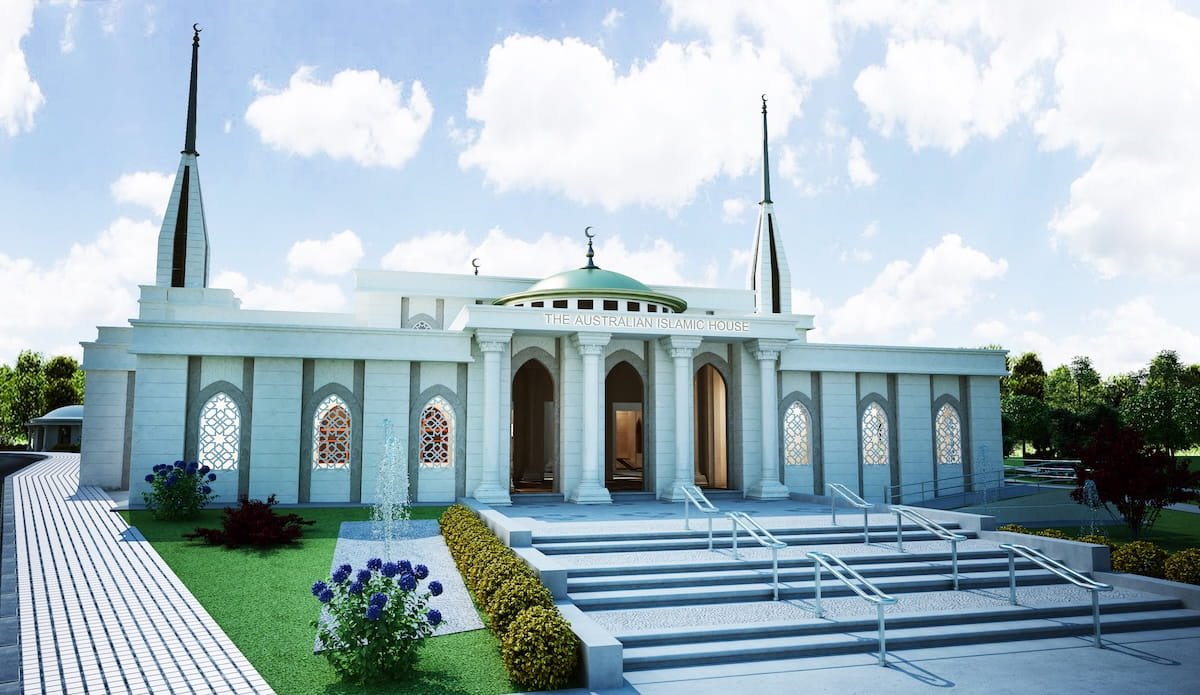
This article explores how the Australian Islamic House shapes its public architectural identity through the entry portal, minarets, and wider site arrangement. It shows how arrival, accessibility, and circulation are carefully organized to express the mosque’s civic, spiritual, and communal presence. To explore this architecture of arrival in greater depth, continue to the detailed reading.