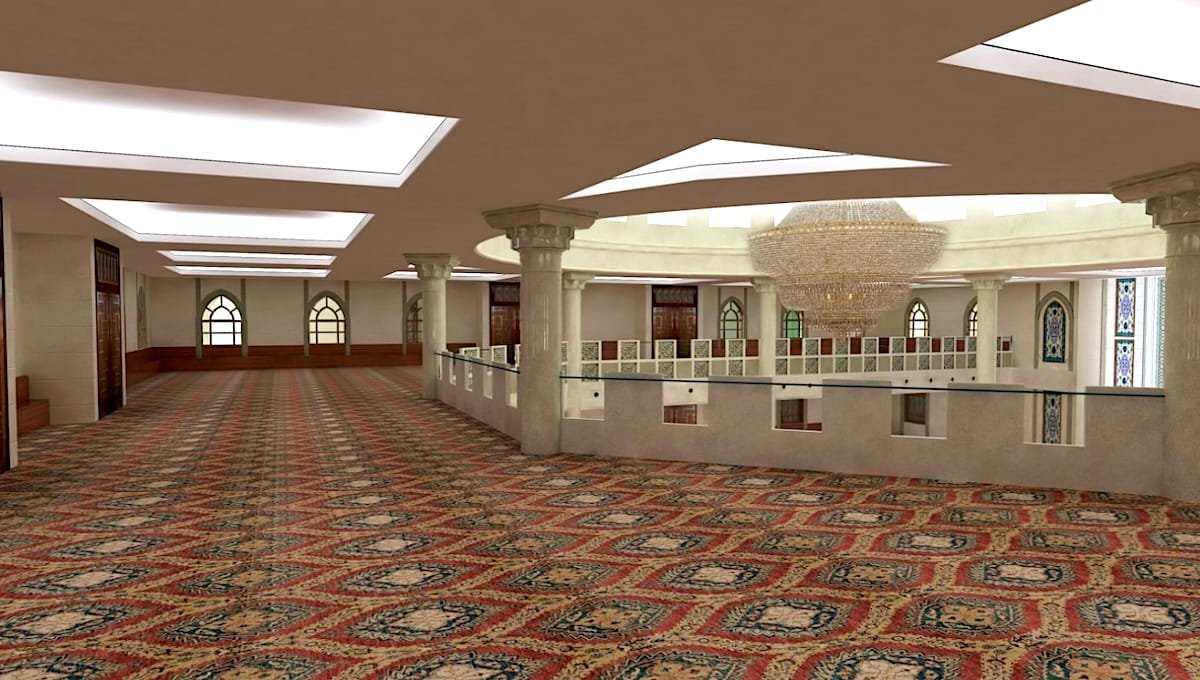
This examination draws attention to a part of the mosque where architectural care becomes especially visible through protection, inclusion, and everyday communal use. Here, the focus falls on Fire Stairs and Fire Safety, the Women’s Prayer Hall, and the broader Community Spaces attached to the upper floors of the building.
Read together, these elements show that the Australian Islamic House is not conceived as a prayer hall alone.It is also a carefully organized environment in which worship, circulation, safety, learning, and social life are brought into a single architectural framework. The upper-level hall appears open, calm, and clearly structured, while the balustrade, skylit ceiling, and surrounding circulation suggest a space designed not only for prayer, but also for orientation, supervision, and shared use.
Women’s Prayer Hall
The Women’s Prayer Hall: (310 m²) accommodates approximately 300-310 worshippers and is designed as a dedicated upper-level prayer space that gives clear priority to accessibility, comfort, and inclusivity. It is served by a separate female entry, wide staircases, and a disabled-friendly lift, creating a direct and dignified route into the upper-level prayer hall and the upper arcade beyond. This arrangement is architecturally significant because it gives women’s worship a spatial identity that is integrated, purposeful, and clearly resolved within the larger plan of the mosque. The women’s hall is not treated as a peripheral zone; it is conceived as a fully developed space within the mosque’s upper-level order.
Its environmental design is equally important. The integration of mashrabiya window screens with surrounding arcade corridors on both the ground and upper floors allows the prayer halls to function as part of a passive sustainable system. Soft, indirect daylight is filtered into the interior, reducing reliance on artificial lighting during the day. At the same time, the strategic placement of a sufficient number of doors and window openings on opposite sides of the surrounding corridors on both floors creates effective cross-ventilation, generating natural, wind-driven cooling and reducing dependence on air conditioning. These decisions reveal a prayer environment shaped not only by liturgical need, but also by climatic intelligence and long-term usability.
The spatial separation of female spaces from the main public areas also plays an important role in the architectural character of the hall. This separation creates a dedicated and peaceful environment for worship, while also helping organize circulation, manage ablution access, and enhance acoustic separation. The upper floor further accommodates separate Special Guest Praying Areas for men and women, as well as the Care Taker’s section, which may require separate access (staircase) to the ground floor. These additional functions show how the upper level extends beyond a single-use prayer zone. It becomes a carefully layered environment in which worship, hospitality, service, and daily management are all given place within a coherent architectural arrangement.
Community Spaces
The Community Spaces underline the wider civic role of the mosque. Located on the upper floors of the two-storey building attached to the south wall of the main structure, these spaces are designed as a social hub while maintaining clear connections to the mosque itself. Their placement allows the main hall to remain focused on prayer, while the surrounding program supports the wider needs of the community through flexible and multifunctional use. This distinction is important because it protects the devotional clarity of the main prayer areas without reducing the mosque to a single ritual function.
At the centre of this upper-level social infrastructure is a flexible & multifunctional library composed of open-plan reading zones and flexible meeting rooms available for community members when needed. Alongside these are a women management room, child play area, coffee kitchenette, store room, separate women ablution & toilets area with disable toilet, separate mail toilet, and a dedicated imam/care taker’s unit with separate entry and stairs. This is a notably rich and practical program. It suggests a mosque environment designed to support reading, conversation, administration, childcare, hospitality, ablution, and daily custodianship within one connected architectural setting.
The upper-level setting feels less like a narrowly specialized floor and more like an open, inhabitable space. The wide carpeted floor, the balustrade overlooking the lower space, and the generous ceiling height suggest a building that understands upper levels not merely as secondary floors, but as active parts of the mosque’s interior life. In that sense, the community spaces do not sit outside the architecture of worship. They expand it into the social, educational, and everyday rhythms of communal life.
Fire Stairs and Fire Safety
The approach to fire safety is treated here as a fundamental architectural responsibility rather than a hidden technical layer. Two fire stairs are integrated into the mosque’s layout: one located next to the ablution area (Fire Stairs 1) and the other behind the mihrab wall (Fire Stairs 2). Both can be used as separate access points for daily, routine circulation when fire safety regulations and performance requirements are applied. This is an important detail because it shows that circulation routes have been designed to serve both everyday use and emergency performance, allowing safety infrastructure to participate in the building’s overall logic of movement.
The mezzanine level is further protected through smoke detection and, depending on size, automatic sprinkler systems installed under and around the mezzanine and linked to the main building alarm system. Two separate fire exits and fire stairs are provided to the mezzanine floor in order to comply with fire safety standards. This arrangement matters especially in a mosque, where periods of high occupancy and the need for rapid evacuation must be anticipated as part of the design. The fire safety strategy is therefore not merely regulatory; it is architectural in the fullest sense, shaping how upper-level spaces remain secure, usable, and responsibly connected to the building as a whole. This design approach aligns with international fire safety standards, particularly in situations where high occupancy or rapid evacuation is required.
An Upper Level Shaped by Care, Inclusion, and Everyday Use
Taken together, Fire Stairs and Fire Safety, the Women’s Prayer Hall, and the Community Spaces show how the upper levels of the Australian Islamic House are shaped by more than accommodation alone. They are organized around a broader architectural ethic of safety, dignity, environmental responsiveness, and communal support. Fire stairs and emergency systems secure the building’s responsibility to protect. The women’s prayer hall gives upper-level worship a calm and inclusive architectural setting. The community spaces extend the mosque into a social and educational hub without distracting from the devotional role of the main hall. What emerges is an architecture that understands care as spatial, practical, and collective, and that gives this understanding durable form across the upper levels of the building.
The architectural reading continues below with the next article, which turns to ablution, sanitary design, and the architecture of everyday care, where hygiene, accessibility, and daily religious use are given clear and considered architectural form.
Previous Article
Masharabiyas, Riwaq, and the Climate-Responsive Language of the Exterior
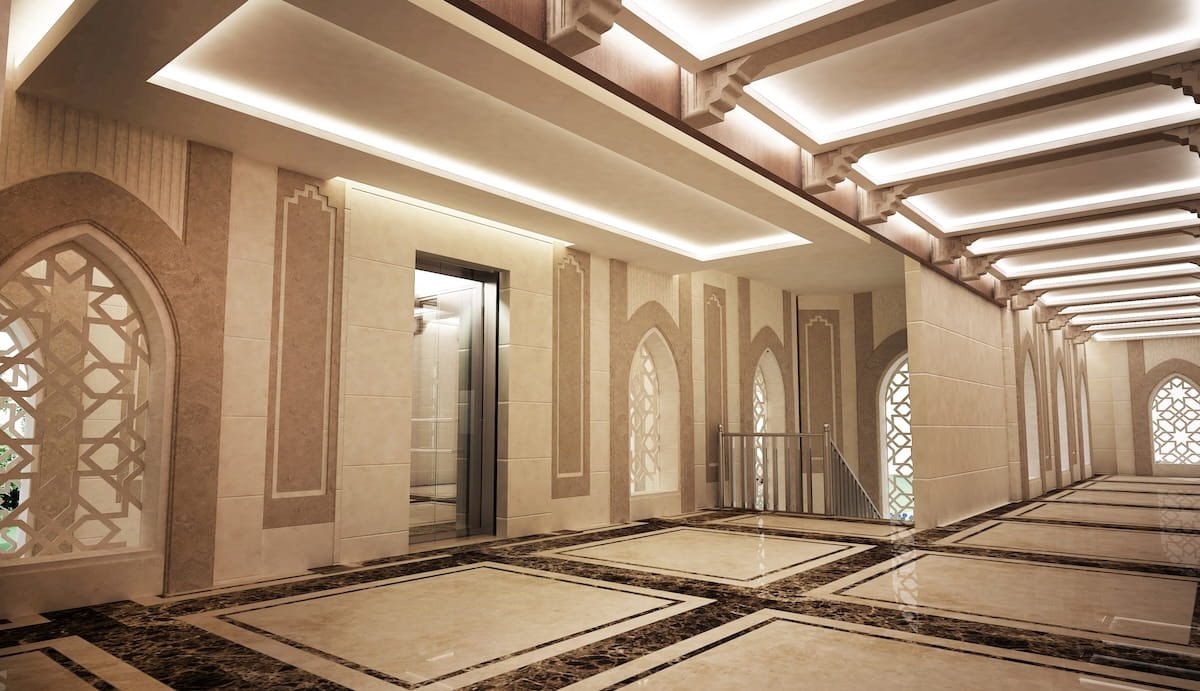
This article explores how the Australian Islamic House develops a climate-responsive exterior language through the relationship between the mashrabiya, the riwaq, and the wider system of light-colored stone cladding, airflow, and shaded circulation. To explore this climate-responsive exterior language further, see the full text.
Next Article
Ablution, Sanitary Design, and the Architecture of Everyday Care
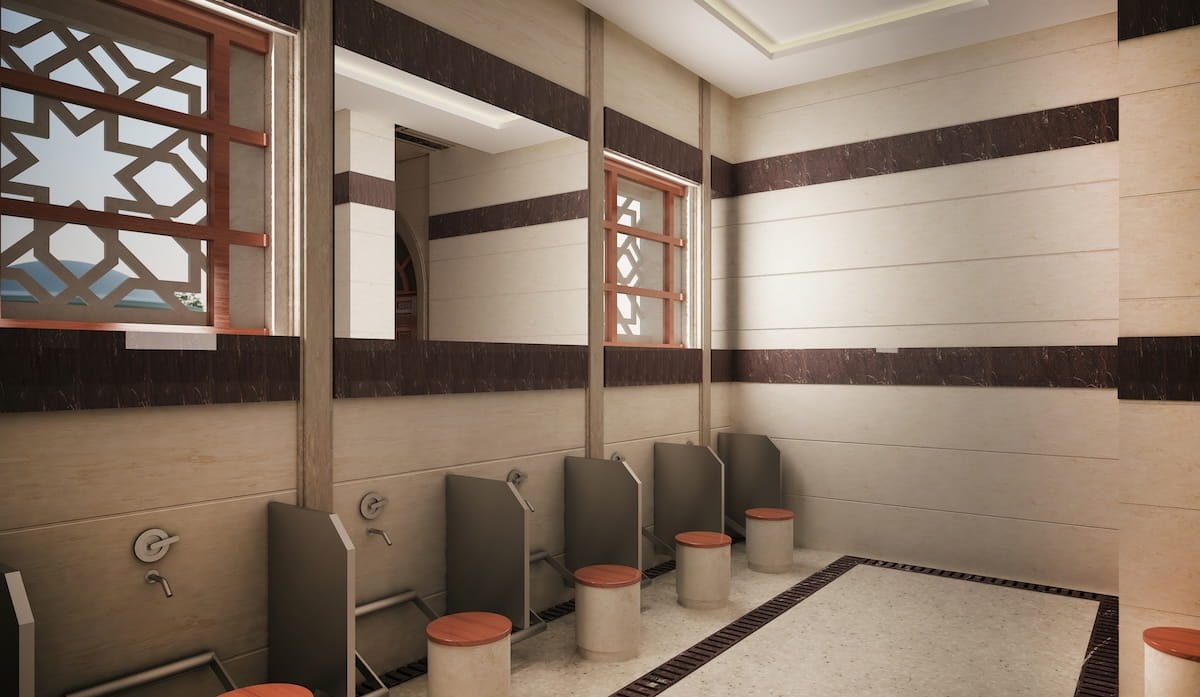
This article turns to the service spaces of the Australian Islamic House, showing how ablution, sanitary design, and care-taking facilities are treated as integral parts of the mosque’s architectural and spiritual life. To explore this architecture of everyday care in greater depth, continue reading here.