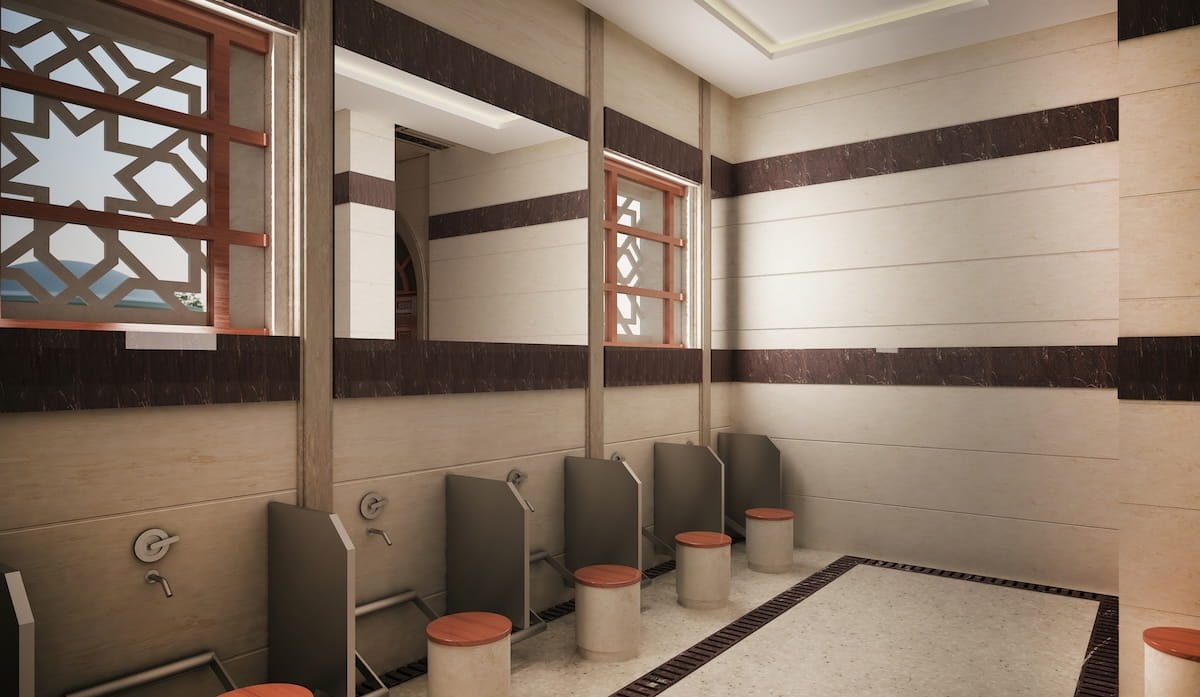
This text turns to a part of mosque architecture that is often treated as secondary, yet in practice reveals a great deal about how a building understands dignity, hygiene, privacy, and daily use. Here, the focus falls on First Floor-Ablution and Sanitary Facilities, Ablution and Sanitary Facilities, and First Floor-Care Takers Unit Sanitary Facilities.
Read together, these spaces show that the Australian Islamic House extends architectural care well beyond the prayer hall itself. Ablution, sanitary use, and service accommodation are treated as integral parts of the building’s functional and spiritual life. The interior appears clean, calm, well lit, and materially ordered, with mashrabiya screens, durable finishes, and a restrained palette contributing to a hygienic and welcoming atmosphere.
Ground Floor-Ablution and Sanitary Facilities
The Ablution and Sanitary Facilities on the ground floor are situated within a separate two-storey multifunctional section adjacent to the main mosque and are described as having a southern orientation. This positioning is significant because it allows easy access while maintaining a degree of separation from the main prayer hall, thereby minimising noise and disturbance. In architectural terms, this supports the integrity of the prayer environment while ensuring that high-use service spaces remain efficiently connected to the larger complex.
Privacy is treated with equal seriousness. The facility includes completely separate entryways for men and women via surrounding walkways, ensuring that movement into and through these spaces remains orderly and respectful. The design also provides step-free access and full disabled-friendly facilities, including wide doorways, ramps, and ample turning space. This combination of separation and accessibility is important because it demonstrates that privacy and inclusiveness are not presented as opposing values. They are resolved together through planning, circulation, and architectural clarity.
Funeral Room & Waiting Room: Funeral room and waiting room located at the back (south) section of the main building next to ablution areas with separate private back entries for family members. The waiting room has a separate door opening to enter the ablution section of the mosque, ensuring that the ablution (wudu) section (a “wet” zone) is easily accessible from the waiting area, yet separated from the “dry” prayer hall with a corridor (walkway) to maintain cleanliness and prevent noise disruption.
Non-slip transition & flooring, adequate drainage, adequate ventilation, quiet airflow to keep the air fresh and comfortable are crucial for hygiene and safety for these spaces to foster quiet dignity, aiding in comfort for the grieving during the final farewell.
The space is designed to facilitate privacy and comfort for families to enhance the calm atmosphere; surrounded with landscaped open community gathering area, amphitheater and the fountain.
These facilities are described as a modern, accessible, and hygienic ablution (Wudu) and sanitary environment, designed to comply with high standards of sanitation and accessibility while reflecting Islamic architectural principles. That balance matters. The spaces are expected to perform to contemporary hygienic standards, but they are still understood as part of the mosque’s architectural language rather than merely utilitarian service zones. Operable windows are again used for natural-ventilation to remove moisture, minimise odors, and prevent mold growth, while natural light is maximised to support a hygienic and welcoming environment. This gives the facilities a consistency of approach across levels: practical performance is joined to spatial dignity and visual calm.
First Floor-Ablution and Sanitary Facilities
The First Floor-Ablution and Sanitary Facilities are positioned adjacent to the women’s prayer hall, creating a layout that responds directly to the needs of contemporary mosque use. Placing ablution and sanitary services on the same level as the prayer hall, and near the community spaces, significantly strengthens accessibility and functional efficiency. This is an important architectural decision because it reduces unnecessary movement between levels and keeps preparation for prayer closely aligned with the spaces of worship and communal life.
The arrangement allows easy access through a dedicated lift and surrounding step-free walkway. This makes the facilities more inclusive and easier to use for a wider range of worshippers. The design also provides disabled-friendly provisions, including wide doorways, ramps, and ample turning space. These details matter because they show that accessibility is not treated as an additional adjustment. It is embedded in the architectural logic of the building. The first-floor facilities are therefore not only convenient. They are designed to support dignity, independence, and comfort in everyday use.
Environmental care is equally visible in the design. Operable windows are placed strategically for natural-ventilation in order to remove moisture, minimise odors, and prevent mold growth. At the same time, the maximised use of natural light helps create a hygienic and welcoming environment. In a space dedicated to preparation and bodily care, these decisions are especially important. They shape not only performance, but atmosphere. The page 1 rendering reinforces this through its bright interior, clear surface treatment, and controlled patterning, suggesting a space that is both practical and composed.
First Floor-Care Takers Unit Sanitary Facilities
The First Floor-Care Takers Unit Sanitary Facilities are located on the second floor next to the community hall and are designed to serve a three-bedroom unit with separate bathrooms and a large laundry. Their inclusion broadens the understanding of the mosque as a lived and managed institution rather than a purely ceremonial building. These sanitary spaces belong to the everyday life of care, maintenance, and long-term occupation that supports the larger functioning of the complex.
All sanitary facilities are designed to comply with high standards of sanitation and accessibility. Access is supported by a dedicated lift and surrounding step-free walkway, while two additional stairs next to the ablution area (Fire Stairs 1) and behind the mihrab wall (Fire Stairs 2) can be used as separate access points for daily, routine circulation when fire safety regulations and performance requirements are applied. This is a notable detail because it ties service accommodation back into the building’s broader circulation and safety strategy. The care taker’s unit is not isolated from the mosque’s architectural logic. It is woven into it through the same concern for access, clarity, and safe movement that appears elsewhere in the project.
The calm material palette, patterned window screens, and controlled use of light suggest that sanitary and service spaces are not treated as visually neglected back-of-house areas. They are given the same level of architectural discipline seen elsewhere in the project.
Hygiene, Access, and the Quiet Discipline of Service Spaces
Taken together, the first-floor ablution facilities, the ground-floor ablution and sanitary areas, and the care taker’s unit sanitary facilities reveal an architecture shaped by everyday responsibility as much as by symbolic form. These are spaces of preparation, maintenance, and bodily care, yet they are treated with notable seriousness. Accessibility is embedded through lifts, ramps, wide doorways, and step-free walkway systems. Hygiene is strengthened through natural-ventilation, daylight, and carefully considered layouts. Privacy is maintained through separate entries and clear circulation. What emerges is a service architecture that is neither hidden nor diminished. Instead, it becomes part of the mosque’s larger ethic of care, showing that architectural quality can and should extend to the spaces that support daily religious life most directly.
The architectural reading continues below with the next article, which turns outward to the fountain, the landscaped amphitheater, and the wider landscape of gathering, where purification, community life, and shared outdoor space are brought into thoughtful architectural form.
Previous Article
Women’s Prayer Hall, The Community Life of the Upper Level and Fire Safety
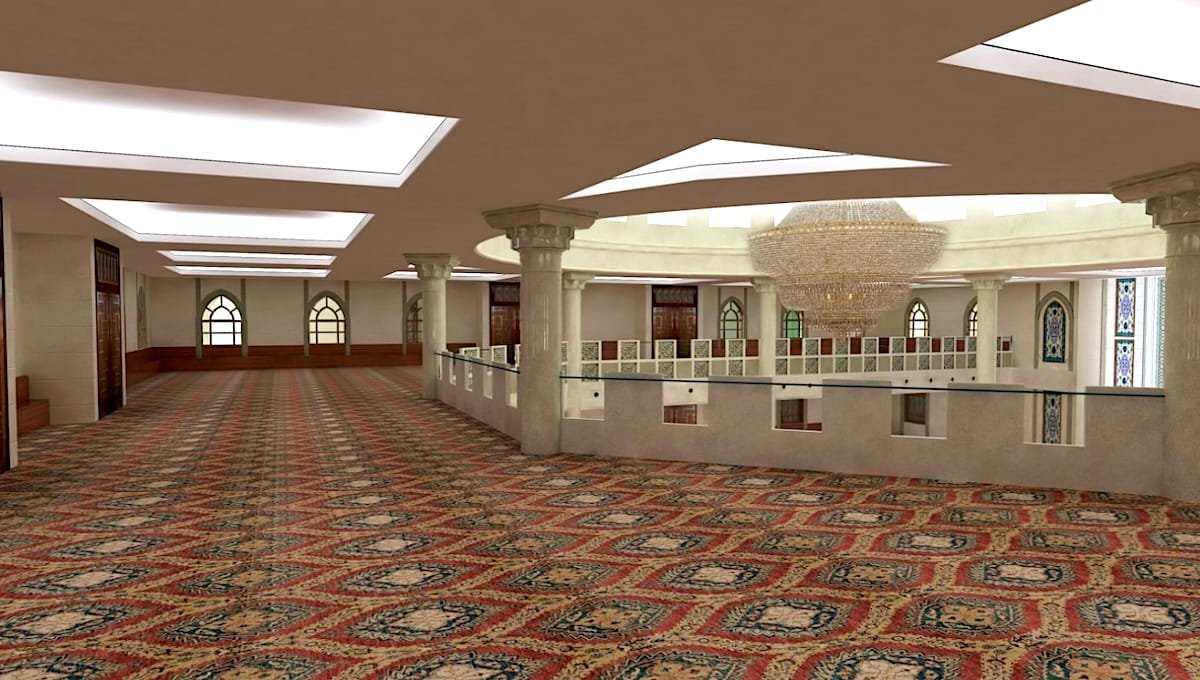
This article turns to the upper levels of the Australian Islamic House, showing how women’s worship, community life, and fire safety are brought into a single architectural framework shaped by care, inclusion, and everyday use. Together, these elements reveal an architecture in which protection, hospitality, accessibility, and communal support are given clear and durable form. To learn more about these upper-level spaces, read the extended reading.
Next Article
Fountain, Amphitheater, and the Landscape of Gathering
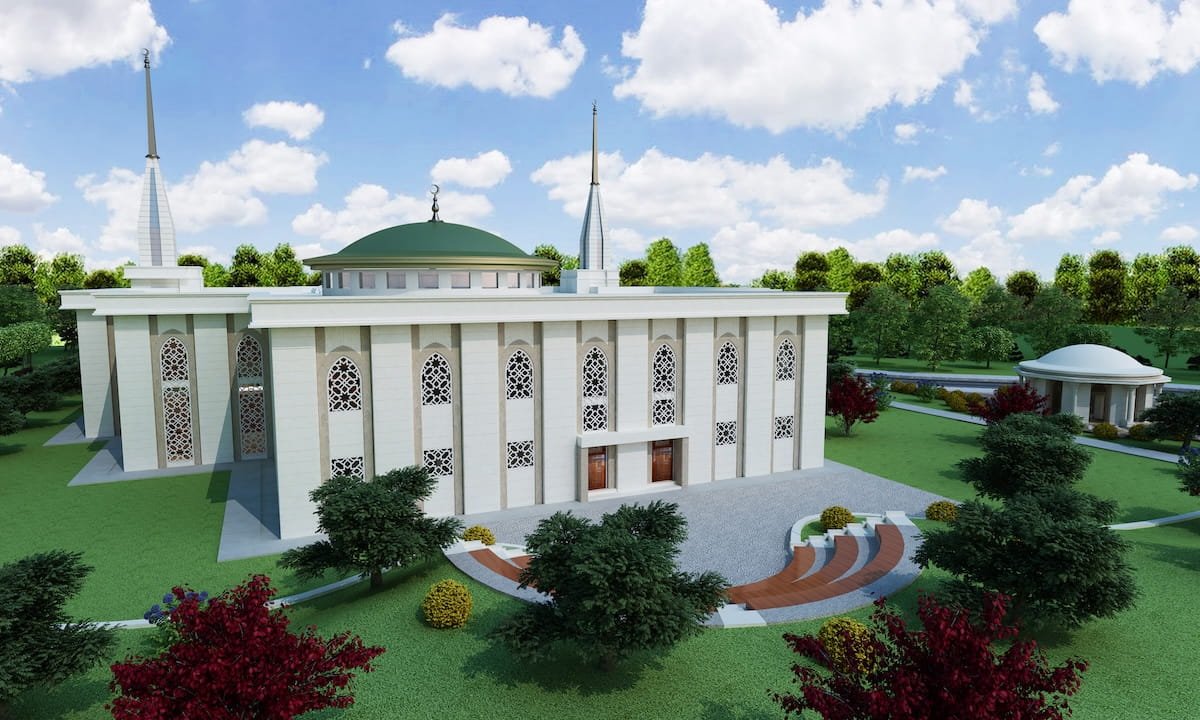
This article turns outward to examine how the Australian Islamic House gives architectural form to gathering, purification, and shared outdoor life through the fountain, the landscaped amphitheater, and the wider system of paths and green spaces. Together, these elements reveal an outdoor architecture of care, one in which the mosque’s civic and spiritual presence extends meaningfully into the terrain that surrounds it. To follow this landscape of gathering more closely, read the complete article.