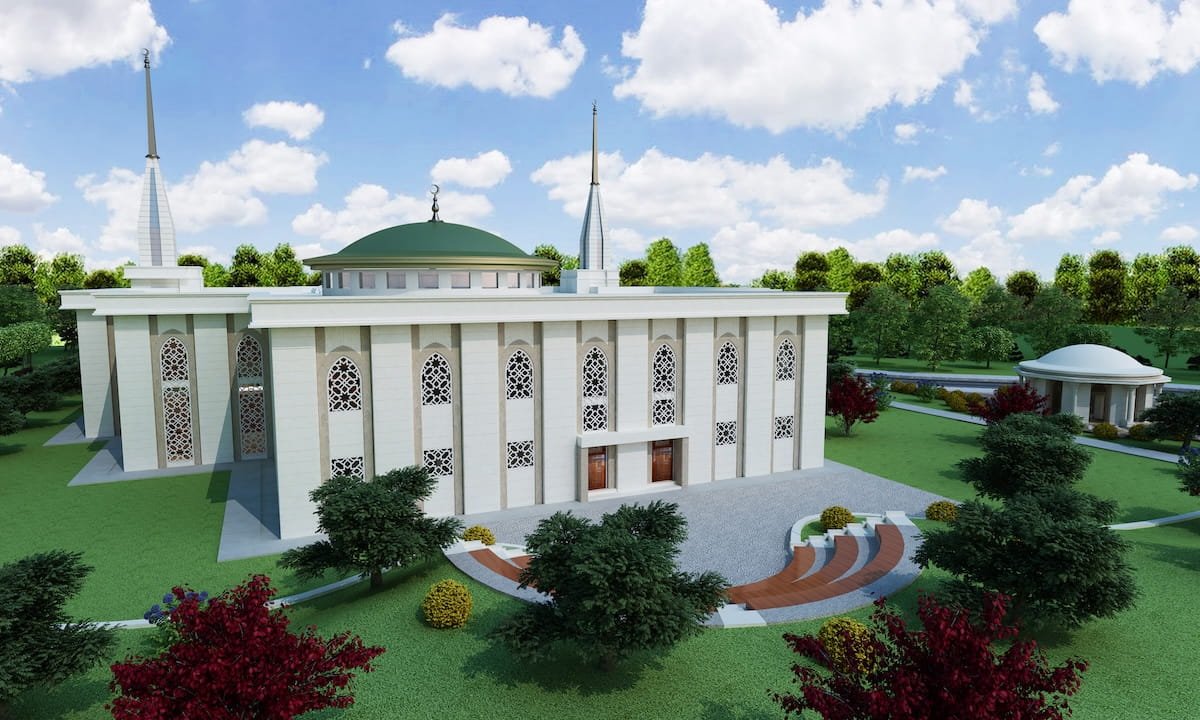
This article turns outward, focusing on the parts of the Australian Islamic House that shape collective life beyond the main building itself. Here, architecture extends into the courtyard, the site edge, and the open landscape through the Fountain (Shadirvan), A Landscaped Amphitheater, and Landscape and Pedestrian Paths and Community Spaces.
Read together, these elements show that the mosque is not conceived only as an enclosed place of worship. It is also designed as a broader setting for purification, gathering, waiting, reflection, and community use. The main building, the landscaped amphitheater, the open green areas, and the small fountain structure are all visible within one coherent exterior composition, suggesting a mosque complex shaped as much by its outdoor life as by its interior spaces.
A Landscaped Amphitheater
A Landscaped Amphitheater is cut into the existing slope at the back, on the south side of the mosque, where the earth itself is used to define the seating tiers. This is a notable landscape decision because it allows the topography of the site to shape the public space rather than requiring the land to be fully flattened or overwritten. The amphitheater is positioned with separate entry doors and conceived as a large multipurpose community gathering area, showing that the mosque’s outdoor spaces are expected to support shared public life as well as devotional use.
The seating tiers are structured as wood-decking benches that follow the natural contour of the land, producing a landscape that is functional, biophilic, and visually composed. This is important because the amphitheater is not treated as an inserted object. It is designed to grow out of the site itself. The blend between seating, slope, and planted surroundings gives the space a softer and more integrated presence, allowing it to feel like part of the larger environmental setting of the mosque.
Accessibility remains central to this design. The amphitheater includes accessible walkways and seating that blend into the landscape, ensuring that the space remains inclusive despite its tiered and sloped character. This is a particularly strong feature of the scheme. It shows that even where the land is shaped into levels and terraces, ease of movement and dignity of use are still treated as architectural priorities. The amphitheater therefore serves as a functional, aesthetic, sustainable, and modern solution, transforming public space into a multipurpose community hub.
The Outdoor Gathering Area also acts as a transitional space, especially suited to Janazah (funeral) prayers. The proposal imagines this zone as a landscaped and serene environment, shaped by simple green spaces and designed to provide a dignified place for community members to gather. This gives the amphitheater and its surroundings a deeper civic and ceremonial role. It is not only a venue for community use in general terms. It is also a space capable of receiving moments of collective mourning, respect, and reflection. The inclusion of Automated giant outdoor umbrellas further strengthens this role by protecting worshippers from sun, rain, and wind, making the outdoor gathering areas more usable across different weather conditions.
Landscape and Pedestrian Paths and Community Spaces
The broader Landscape and Pedestrian Paths and Community Spaces show how the mosque is integrated into both its natural and urban surroundings. The site design focuses on high accessibility, user-friendly shaded pathways, and functional community spaces, while also seeking to place the building within a coherent landscape framework. This is an important aspect of the project because it means the experience of the mosque begins before the threshold of the building itself. It begins in the paths, planted areas, shaded routes, and open spaces that guide people toward and around the complex.
Roadside trees are described as vital “green infrastructure”, acting as natural filters for pollution and as effective sound barriers that mitigate the impact of heavy traffic on nearby communities. Strategically planted trees and shrubs can reduce noise levels and support Improved Air Quality. This gives the landscape an environmental function that goes beyond beautification. The planted edges help create a more protected and breathable setting for the mosque and its users, reinforcing the idea that landscape design is part of the site’s civic responsibility.
At the same time, landscaped green areas, the amphitheater, and shaded walkways encourage relaxation and social interaction. This detail matters because it positions the exterior not simply as circulation space, but as a place where people may linger, meet, and gather. In that sense, the pedestrian paths and community spaces support a more generous reading of the mosque complex. They suggest an environment designed not only for arrival and departure, but also for presence, connection, and everyday community life.
The main building is set within open green areas, with curved paths, planted zones, and the amphitheater all contributing to a setting that feels deliberate rather than leftover. The exterior spaces are composed as part of the architectural whole, giving the mosque a broader territorial and communal presence.
Fountain (Shadirvan)
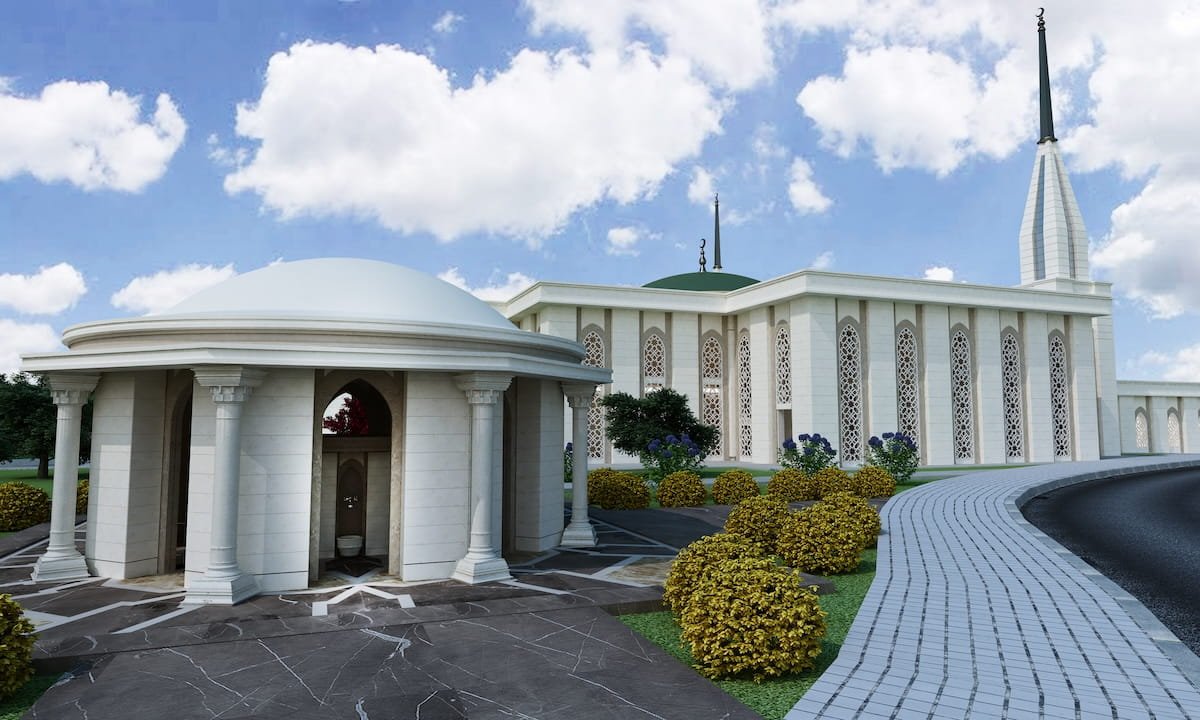
The Fountain (Shadirvan) is located in the courtyard, near the back entrances, to the east of the main building, and close to the accessible, ablution, and funeral areas. This placement is strategic in both practical and symbolic terms. It ensures convenient access to water for ritual washing (wudu) before prayer, while also reinforcing the role of purification as part of the mosque’s architectural order. The ablution fountain, or Shadirvan, is a common feature in mosques for community use, and here it is positioned where preparation, movement, and collective ritual life come together naturally.
Its architectural treatment is equally important. The fountain is contemporary in design, yet it is integrated through the same cladding, columns, and stylistic elements as the mosque’s main entrance. This creates a cohesive, aesthetic, and spiritual atmosphere rather than allowing the fountain to appear as an isolated landscape object. The effect is one of continuity. The courtyard (sahn) and the main structure are brought into visual and material relationship through a shared architectural language that blends modern design with traditional materials, especially natural stone. In this way, the Shadirvan does more than provide water. It strengthens the unity of the courtyard and contributes to the mosque’s larger sense of composure and ritual coherence.
Indirect LED lighting is used to generate a calm ambiance, drawing attention to the texture of the wall rather than relying on overt decorative excess. This is an effective architectural move because it allows the space of ablution to feel composed and contemplative. Instead of separating ritual function from aesthetic experience, the design allows the act of purification to take place in an environment shaped by light, material, and restraint. The Shadirvan therefore works on several levels at once. It is functional, symbolic, atmospheric, and architecturally connective.
This shows the Shadirvan not as a detached feature, but as part of the mosque’s exterior spatial field. Its modest scale and pavilion-like presence allow it to serve both practical use and atmospheric continuity within the landscaped setting.
An Exterior Setting Shaped by Purification, Gathering, and Care
Taken together, the Fountain (Shadirvan), A Landscaped Amphitheater, and Landscape and Pedestrian Paths and Community Spaces reveal a mosque complex whose outdoor life has been given architectural dignity. The fountain supports ritual preparation and strengthens the cohesion of courtyard and building. The amphitheater transforms the natural slope into a socially and ceremonially meaningful gathering place. The wider landscape and pedestrian system provide accessibility, environmental benefit, and everyday opportunities for meeting and pause. What emerges is an exterior architecture of care, where purification, community gathering, climate responsiveness, and civic generosity are brought into one coherent setting. In the Australian Islamic House, the landscape is not secondary to the building. It is part of the way the mosque welcomes, prepares, and holds the life of its community.
The architectural reading continues below with the next article, which traces the design and construction process of the Australian Islamic House, following the project from early concept to built form through continuity, collaboration, and sustained architectural oversight.
Previous Article
Ablution, Sanitary Design, and the Architecture of Everyday Care
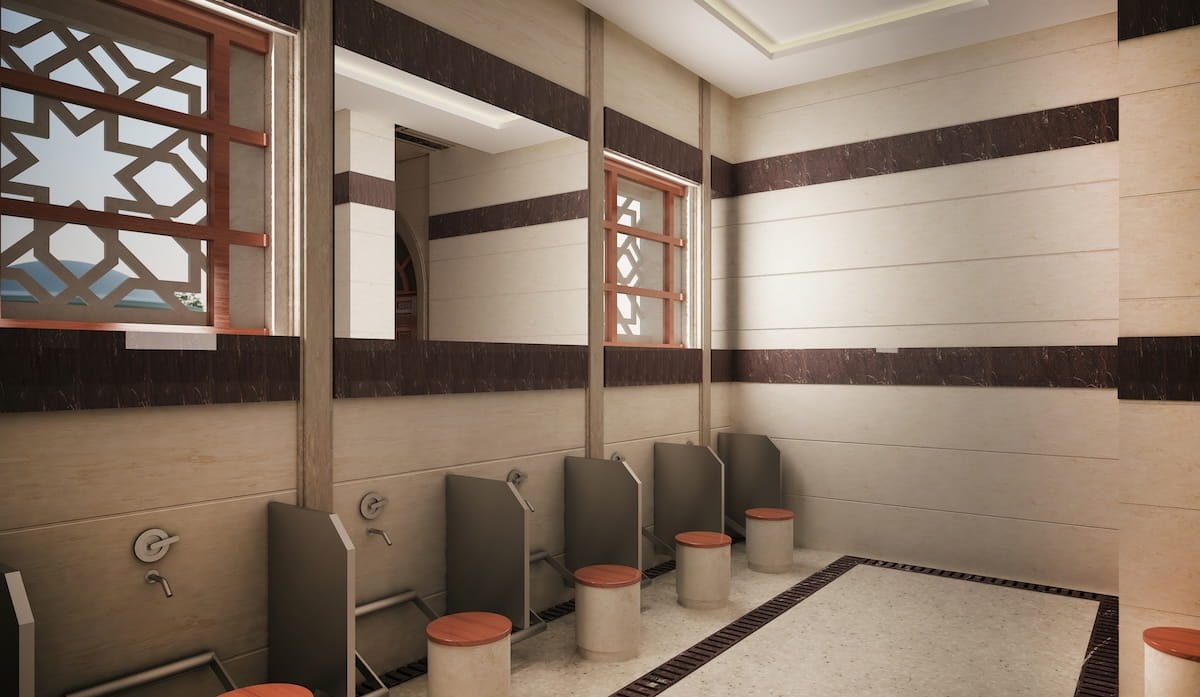
This article turns to the service spaces of the Australian Islamic House, showing how ablution, sanitary design, and care-taking facilities are treated as integral parts of the mosque’s architectural and spiritual life. To explore this architecture of everyday care in greater depth, continue reading here.
Next Article
Design and Construction Process

This article traces the Australian Islamic House through its long design and construction process, revealing a project shaped by continuity, collaboration, and sustained architectural oversight rather than by a single moment of completion. To trace the project from concept to built form, explore the full study.